Installed battery storage capacity in California has grown from just 500MW in 2018 to more than 13,300MW at the latest count.
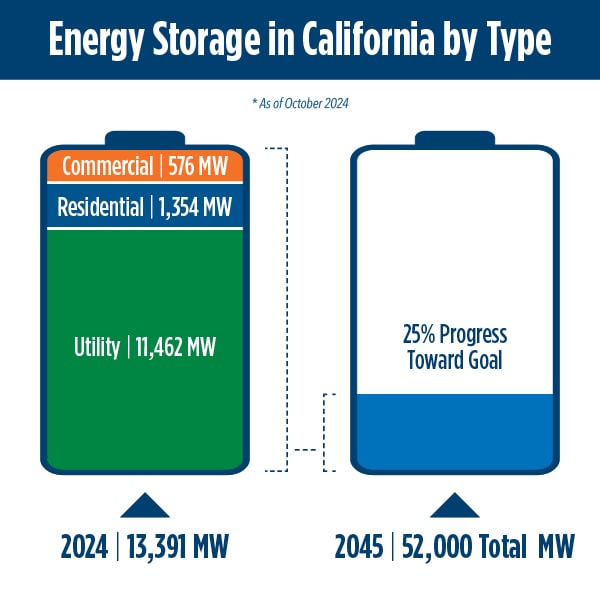
According to the newest Energy Storage Survey published by the California Energy Commission (CEC), as of 11 September 2024, there is 13,391MW of cumulative battery storage capacity in the US state.
Hailing the “remarkable progress,” trade group California Energy Storage Alliance (CESA) noted that this represents 3,000MW of growth in the last six months alone. When the CEC published its previous edition of the Survey in April, the Golden State had just passed the 10GW mark.
When that milestone was passed, with cumulative installs at 10,379MW, batteries became the biggest single contributor of power to the California Independent System Operator (CAISO) grid for a short time on the evening of 16 April 2024. California Governor Gavin Newsom said that the state’s “energy storage revolution is here.”
Try Premium for just $1
- Full premium access for the first month at only $1
- Converts to an annual rate after 30 days unless cancelled
- Cancel anytime during the trial period
Premium Benefits
- Expert industry analysis and interviews
- Digital access to PV Tech Power journal
- Exclusive event discounts
Or get the full Premium subscription right away
Or continue reading this article for free
California is already 25% of the way to deploying 52,000MW of storage by 2045, the year it targets achieving carbon neutrality and reducing emissions by at least 85% below 1990 levels.
When Newsom took office in 2019, there was just 770MW on the grid, meaning installations have grown 1,639% during his tenure, which CESA claimed as a “major victory on the path to 100% clean electricity.”
The majority of the US’ energy storage market is focused on utility-scale, or grid-scale battery energy storage systems (BESS), as has been reported by the quarterly ‘US Energy Storage Monitor’ from research firm Wood Mackenzie.
California, which Wood Mackenzie has consistently identified as one of the top three states for deployments, is no different.
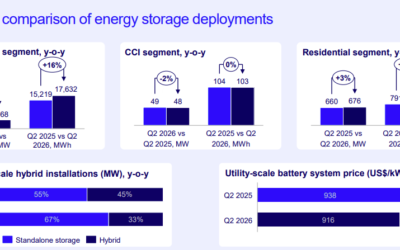
The CEC survey said California’s battery storage installs comprise 11,462MW of utility-scale battery energy storage systems, 1,354MW of residential batteries, and just 576MW in the commercial and industrial (C&I) market segment.
Newsom’s mixed report card from clean energy industry groups
Despite drawing the praise of the energy storage group, Newsom’s recent record has been less warmly greeted by counterparts in the solar PV industry. The governor has drawn fierce criticism from groups including the California Solar & Storage Association (CALSSA) for allowing the end of the state’s popular net metering programme for distributed solar resources.

Its replacement, NEM 3.0, reduced net metering compensation rates by about 75% for customers of California’s three big investor-owned utilities, which has conversely decreased the payback time for customers that install a battery system and self-consume their solar-generated power rather than export it to the grid.
Newsom drew further ire from CALSSA in September when he vetoed a bill that would enable schools and multi-family dwellings, like apartment complexes, to self-consume onsite generated solar.
In the same legislative session however, the governor did pass a bill to allow for vehicle-to-grid (V2G) and vehicle-to-home (V2H) bidirectional charging of electric vehicles.
California’s lead in the US energy storage market pre-dates Newsom’s run as governor. Assembly Bill 2514 (AB2514), legislation passed in 2013 by then-governor Jerry Brown, set a nation-first energy storage target mandate for investor-owned utilities (IOUs) to procure 1.325GW of storage by 2020, which was easily surpassed ahead of time.
The need for storage had become clear as California was on a renewables adoption trajectory that saw the grid go from 3GW of solar PV in 2008 to more than 12.5GW seven years later in 2015.
Newsom has certainly been supportive of energy storage’s accelerated growth, and has taken steps such as legislating for long-duration energy storage (LDES) resources of 8-hour duration and expediting capacity procurements for clean or flexible resources, including solar, batteries and gas. Energy storage is central to the state’s roadmap to 2045 clean energy goals, as put into action by the governor.