
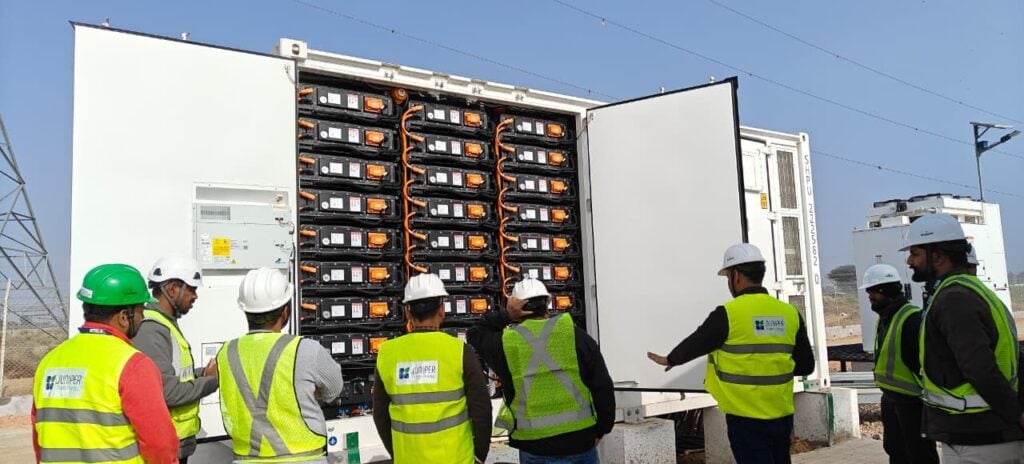
Debmalya Sen, president of the India Energy Storage Alliance (IESA), on a dynamic market landscape of tenders, tariffs and the race to build a domestic battery storage ecosystem.
India’s energy storage journey has not been smooth. As a country late to accelerate lithium-ion battery manufacturing — still the dominant technology, and likely to remain so at least till the middle of next decade — India has relied heavily on imports to meet its growing battery storage demand.
The numbers tell a story of scale: 215 energy storage-linked tenders have been issued since 2018, totalling 308GWh of capacity, comprising 167GWh battery energy storage systems (BESS) and 142GWh pumped hydro energy storage (PHES). Of this, only 13.7GWh was actually operational as of September 2026 — though that figure has jumped 17x since December 2025 and is expected to reach ~20GWh by the end of fiscal year 2026 (FY26).
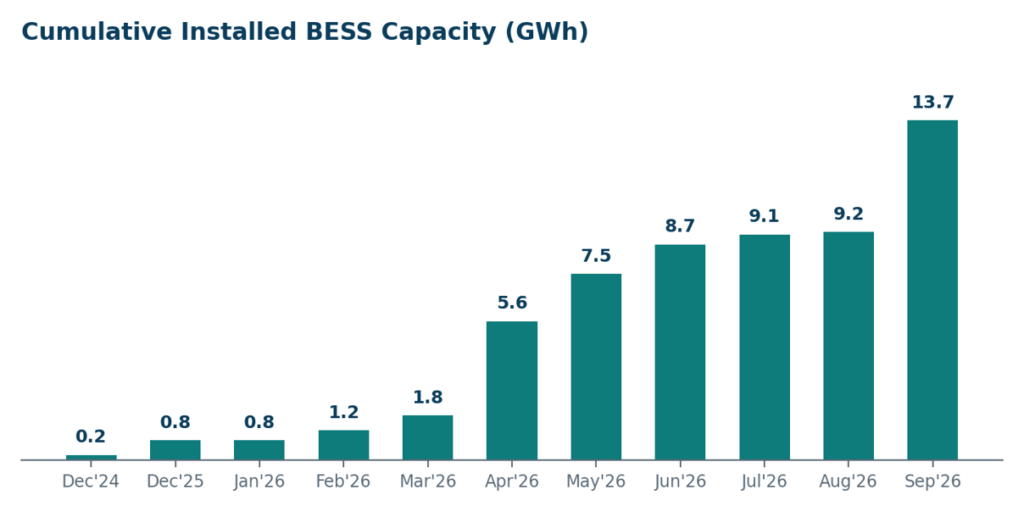
37% of tendered ESS capacity is under execution. 20% has already been cancelled — a reminder that announced capacity is not delivered capacity.
Try Premium for just $1
- Full premium access for the first month at only $1
- Converts to an annual rate after 30 days unless cancelled
- Cancel anytime during the trial period
Premium Benefits
- Expert industry analysis and interviews
- Digital access to PV Tech Power journal
- Exclusive event discounts
Or get the full Premium subscription right away
Or continue reading this article for free
The supply-side gap
While demand-side acceleration is praiseworthy, the picture is far less encouraging upstream. India’s installed lithium-ion cell manufacturing capacity — the largest revenue pool in the value chain — stands at just ~2GWh today, forcing continued reliance on imports. Currently announced capacity is expected to reach only 60–70GWh by 2030.
The story improves somewhat at the assembly stage: cell/pack-to-container (BESS) capacity is expected to range between 180–220GWh by 2030. But these are announced, nameplate figures — not everything projected will materialise, and even what does will not run at full utilisation, which will keep pressuring costs relative to China.
Policy aims to close the gap
The Government of India has leaned on PLI schemes, higher Basic Customs Duty on imports, increased GST, and Minimum Local Content (MLC) and ALMM-style clauses to make domestic manufacturing more attractive. The question remains whether these will be enough to build a cost-competitive ecosystem rather than one propped up by policy alone.
Recent enablers add real weight to that effort: the CEA has proposed mandatory storage for new solar and wind projects from 2027, including grid-forming capability; the Cabinet has approved Phase 3 of the Green Energy Corridor scheme, with INR50,000 crore (US$5.19 billion) earmarked for 50GWh of BESS development; and there’s a proposal to raise MLC to at least 40% in all future bids. States are joining in too — Chhattisgarh has proposed mandatory BESS for RE projects above 5MW, and Kerala’s KSERC has proposed an 85% round-trip efficiency (RTE) benchmark.
A market learning to price risk
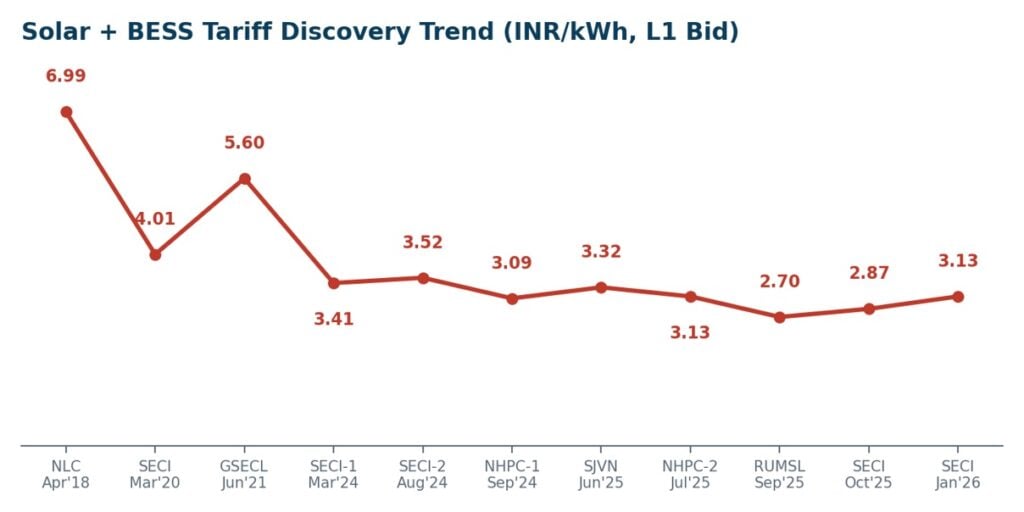
Perhaps the clearest sign of maturity is in tariff behaviour. Solar-plus-BESS tariffs fell from INR 6.99/kWh in 2018 to INR 3.13/kWh by January 2026 — but they’ve essentially plateaued between INR 2.7–3.5/kWh since mid-2024, even as BESS capacity per project grew from roughly 1GWh to 3.6–4GWh. The era of a fresh record-low L1 in every bid appears to be over.
Standalone BESS tariffs tell an even sharper version of this story: having bottomed out at INR 1.48 lacs/MW/month (APTRANSCO, November 2025), they’ve since rebounded nearly 59% to INR 2.35 lacs/MW/month by September 2026.
Rising battery raw material costs have pushed several re-tendered bids — including at MSEDCL and SJVN’s e-RA — to discover tariffs at least one lakh above their previous discovery. Yet this hasn’t dented tendering activity, which paused briefly but is back in full swing, with roughly 12GWh of fresh tenders issued in September alone.
Adani’s portfolio at Khavda has reached 6.63 GWh — now the largest single-location battery plant in the world.
Merchant BESS has emerged as the standout growth story, with ACME’s Rajasthan portfolio also standing at 4.95GWh. September also brought a notable first — DERC approved the tariff for BSES Rajdhani’s 12.5MW/25MWh project, India’s first grid-forming (GFM) BESS project — alongside the usual mix of setbacks (GR Infra terminating its NTPC contract) and progress (ACME and Juniper commissioning new capacity).
What comes next
There’s growing recognition that energy arbitrage alone cannot support the scale of capacity now being built. Ancillary services, storage as a transmission asset, and multi-revenue stacking all need to be explored; these, together with commercial and industrial (C&I) installations, will likely drive incremental storage growth over the next few years.
Rising cell costs have also revived interest in sodium-ion (Na-ion) as an alternative chemistry — NTPC has already floated an EoI for a 100kWh sodium-ion system. But lithium iron phosphate (LFP) itself has a technology roadmap mapped out to 2035, much as nickel manganese cobalt (NMC) did a few years ago.
The real question may not be which chemistry ‘wins’ — but how lithium-ion, sodium-ion, and whatever comes next end up coexisting across different use cases.
India’s storage ambition is real. The next few years will decide how much of the announced pipeline — gigafactories and tenders alike — actually materialises.
Read IESA president Debmalya Sen’s previous Guest Blog for Energy-Storage.news from January 2026: India’s energy storage market in 2025: From tenders to scaled deployment
About the Author
Debmalya Sen is the president of India Energy Storage Alliance (IESA). He works closely with the government and private sector to provide key recommendations on energy storage and is also a recognised subject-matter expert in energy storage by the Central Electricity Authority. Before joining IESA, Debmalya was the India Lead of the World Economic Forum and a management consultant in KPMG, where he led advisory work on energy storage and renewables. Debmalya is also a mentor selected by ESMAP (World Bank) for energy storage, and he mentors young women engineers interested in pursuing a career in the energy storage domain.
The Renewable Energy India Expo and The Battery Show India will run from 22-24 October 2026 at India Expo Mart, Greater Noida, bringing together developers, utilities and global technology providers. The event is co-located with the Energy Storage Summit India, now in its second annual edition, which will offer a dedicated agenda for asset owners, developers and policymakers working through the commercial and regulatory questions shaping India’s energy storage build-out.
