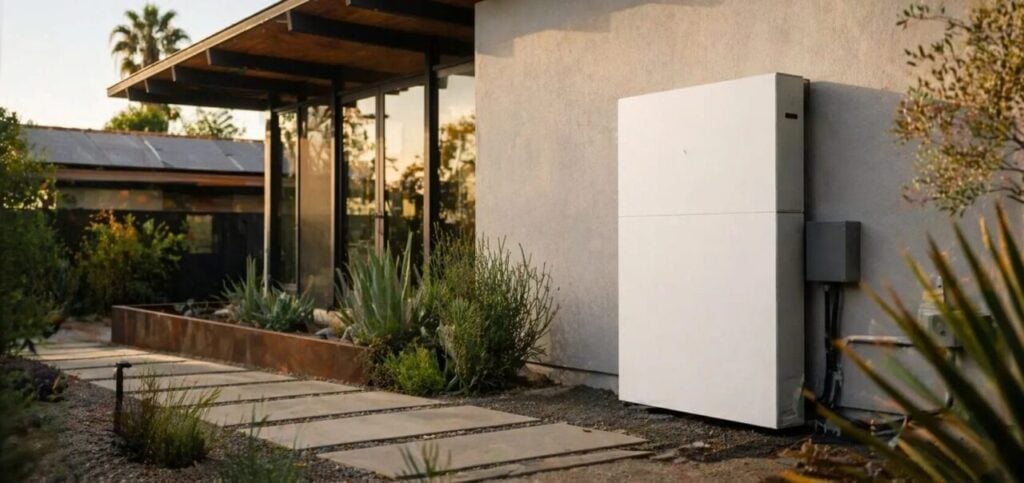
Residential renewable energy solutions company Palmetto recently launched its Palmetto Energy Backup Plan, a residential battery subscription aimed at making residential storage more accessible in 25 US states.
Announced 8 July, Energy Backup Plan has no upfront payment and a fixed US$150 monthly fee for 12 years. The plan targets an estimated 4 to 4.5 million homes that have rooftop solar but no battery energy storage system (BESS) backup.
Speaking with Energy-Storage.news, Jesse Brennan, director of business development, battery and home electrification at Palmetto, draws parallels to the growth of solar third-party ownership (TPO) models, “Prior to solar TPO, residential solar was a cottage industry with around 30,000 systems in 2006.
He continues, “The first viable TPO products hit the market in 2007 and 2008, and installations grew by around 70x over the following decade. We see the Palmetto Energy Backup lease as providing the same value: access without upfront cash, and warranties and performance guarantees. Given the growing demand for home power resiliency, we think demand for this product could far outstrip the demand for solar.”
Try Premium for just $1
- Full premium access for the first month at only $1
- Converts to an annual rate after 30 days unless cancelled
- Cancel anytime during the trial period
Premium Benefits
- Expert industry analysis and interviews
- Digital access to PV Tech Power journal
- Exclusive event discounts
Or get the full Premium subscription right away
Or continue reading this article for free
The subscription approach reflects broader trends in renewables financing. In May 2025, our colleagues at PV Tech reported that, according to market research firm Wood Mackenzie, the market share of TPO of non-residential projects in the US increased to 72% in 2024, up from 69% in 2023.
Nexamp, Summit Ridge Energy, and Standard Solar—owned by renewable energy major Brookfield Renewable—were the top three community solar developers by TPO market share in 2024, holding 7%, 6.5%, and 5.3% respectively.
Brennan says that for a typical residential BESS costing around US$18,000 to install, the lease totals US$21,820 over 12 years. The same system financed with a standard personal loan plus servicing costs would run over US$40,000.
“The loans often have term lengths longer than the useful life of these systems, these batteries are expected to last 12 to 15 years at best, unlike solar with 25 to 30-year lifespans,” he says.
The subscription model also addresses a primary sales objection for dealers and partners by removing upfront costs. Palmetto handles all maintenance and repairs throughout the 12-year loan term.
Brennan notes that increasing outages are changing the value proposition for residential storage, “If you expect an hour or two of outages every year, the math on energy backup is not compelling. If you’re expecting a day or more of outages every year, energy backup goes from nice-to-have to must-have.”
This is compounded by rising temperatures and vulnerable populations, plus the 23% to 25% of Americans now working from home who require reliable power.
Policy varies by market
Brennan also notes that California’s net metering programme, NEM 3.0, enacted three years ago, drove an estimated 40,000 to 50,000 residential battery installations, highlighting the critical role that policy plays by market.
NEM offers an above market rate retail tariff for residential solar PV exports to the California Independent System Operator (CAISO) grid. NEM 3.0 was proposed to cut export rates by approximately 75% as California and the California Public Utilities Commission (CPUC) changed to a new valuation model for self-generated energy.
While some markets offer rate arbitrage opportunities, that allow customers to store energy during off-peak hours and use it during expensive peak periods, Brennan says backup power remains the primary driver. For example, Texas and Florida are Palmetto’s two largest standalone storage markets, neither with arbitrage value.
Palmetto can also aggregate battery capacity for VPP programmess but Brennan claims it passes most VPP incentives to customers to reduce their costs, further stating that in some markets, VPP incentives can cover well over half of a customer’s lease payment—in the richest markets, close to 100% of the cost.
Brennan says long-term success requires cost competitiveness, reliable service, and customer access, and that for Palmetto’s Energy Backup Plan, “we see the greatest value for this product, currently, as a retrofit to residential PV systems so that customers can get greater value from their solar system and answer the big question: what happens when the lights go out.”