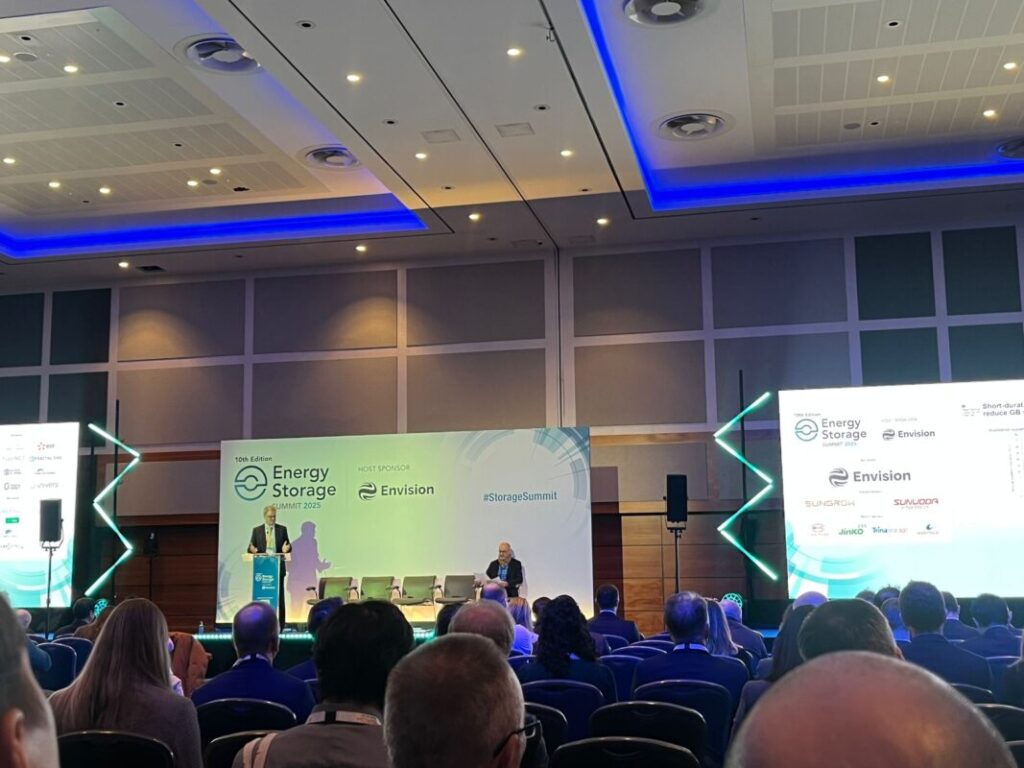
“Short duration flexibility has a massive role to play in reducing the costs of the Great British energy system, saving £10 billion a year by 2050,” Duncan Stone said this morning at the Energy Storage Summit 2025 in the UK.
Stone, deputy director for smart electricity systems in the UK government’s Department for Energy Security and Net Zero (DESNZ), emphasised that storage is a priority for the government.
“Electricity storage is absolutely essential to enabling the rollout of renewables central to our plan for clean power by 2030 because it is really good for system cost and obviously consumer bills.”
The £10 billion in savings Stone mentioned covers expenditure on interconnection, consumer flexibility and system cost. The UK government’s Clean Power 2030 (CP30) action plan sets out the renewable capacity needed for the UK electricity system to be powered almost entirely by ‘clean’ sources.
Try Premium for just $1
- Full premium access for the first month at only $1
- Converts to an annual rate after 30 days unless cancelled
- Cancel anytime during the trial period
Premium Benefits
- Expert industry analysis and interviews
- Digital access to PV Tech Power journal
- Exclusive event discounts
Or get the full Premium subscription right away
Or continue reading this article for free
The range of short-duration energy storage capacity that the government sees supporting its CP30 mission is a five-to-sixfold increase in current online capacity to 23-27GW in 2030.
According to Stone, “If you look at how batteries are functioning in the Capacity Market, progress is already evident”.
While the UK market for lithium-ion battery storage is reaching maturity, new longer-duration storage has not been built in the country for forty years, which Stone said is “remarkable.”
CP30 also sets a target capacity for the UK’s long-duration energy storage (LDES) capacity, a comparatively modest 4-6GW, but “more is expected in 2030 given the long lead times”.
The UK government is working to enable market access for storage. Its anticipated flexibility roadmap, along with the new cap-and-floor investment support scheme, is expected to set a precedent for LDES rollout.
Stone said that the mechanism is similar to that available for electricity interconnection projects, which makes sense since the challenges faced by both technologies have been similar: both are dependent on long-term market revenues, are capex heavy and have long lead times.
He commented: “It’s absolutely right that we bring the financial support we’ve had for interconnectors to LDES assets.” He also confirmed that the UK’s energy regulator Ofgem, which is overseeing the mechanism, is opening the first round of the scheme in Q2 this year.