Faced with unprecedented growth in demand, Singapore’s Energy Market Authority (EMA) has launched an Energy Infrastructure Plan that includes a gigawatt-hour energy storage target.
The EMA, the government Ministry of Energy, Trade and Industry agency tasked with overseeing the city-state’s electricity and gas sectors, said in an announcement this morning that the new five-year plan aims to meet demand growth “reliably and with resilience.”
From peak electricity demand of 8.6GW registered in August in Singapore, the EMA forecasts that within five years, peak demand could reach 9.9GW to 13GW, driven mainly by semiconductor manufacturing, data centres and other electrification trends such as the uptake of electric vehicles (EVs).
The main points of the Energy Infrastructure Plan are the addition of new electric generation capacity from natural gas, an increase in LNG regasification capacity, expansion of the transmission and distribution (T&D) network, an increase in solar PV generation and energy storage capacity and cross-border electricity imports.
Try Premium for just $1
- Full premium access for the first month at only $1
- Converts to an annual rate after 30 days unless cancelled
- Cancel anytime during the trial period
Premium Benefits
- Expert industry analysis and interviews
- Digital access to PV Tech Power journal
- Exclusive event discounts
Or get the full Premium subscription right away
Or continue reading this article for free
Solar PV will be deployed at underutilised sites including reservoirs, vacant land and rooftops. An existing 3GWp by 2030 solar target is already well on the way to being met, with around 2.3GWp of cumulative installs to date. The EMA has now expanded the target to 4GWp by 2035.
Energy Storage Vision consultation
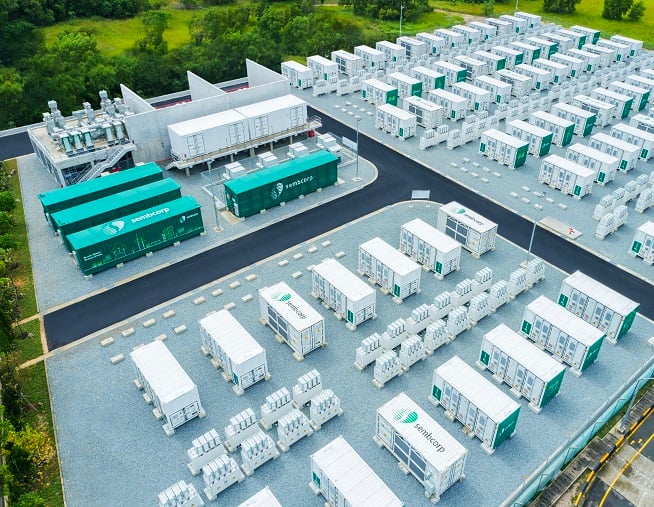
Energy storage deployments in Singapore have reached around 350MWh of operational capacity today. The EMA had previously set a 200MWh target by 2025, which was reached two years early in 2023 with the COD of a 200MW/285MWh lithium iron phosphate (LFP) battery energy storage system (BESS) on Jurong Island, a hub of industrial activity for Singapore.
The EMA said today that the country will now pursue “just over 1GWh” of energy storage deployments by 2030.
In addition to the launch of the Energy Infrastructure Plan, the EMA today published an Energy Storage Systems Vision and Industry Consultation Paper, seeking industry input on how to achieve the 1GWh+ target.
Singapore’s energy system enjoys high levels of reliability today, but rising demand coupled with the need to integrate variable renewable energy (VRE), including rooftop solar, into the grid means greater flexibility to adjust supply and demand will be needed.
“Singapore’s need for flexibility in the power system is growing. We would like to partner companies to turn promising ideas into commercially viable energy storage solutions that can be deployed at scale,” EMA chief executive Puah Kok Keong said.
“By doing so, we can strengthen power system reliability while making better use of every storage.”
The EMA said it will improve access to energy market information and review existing rules, while investigating the roles energy storage can play, inviting suggestions of technologies, business models and projects while also seeking feedback on existing rules and frameworks. The consultation is open until 27 January 2027 and can be viewed and responded to via the EMA site.
A recent survey of BESS market investment trends in Japan, Singapore and Australia by law firm DLA Piper found that almost two-thirds of Singapore respondents saw merchant BESS as attractive and viewed the predictability of EMA-set market rules favourably.
Of the three Asia-Pacific regions surveyed, Singapore also had by far the highest percentage of respondents who described data centre developers as important counterparties for energy storage contracts.
Gas remains central alongside T&D upgrades, cross-border imports
In terms of other aspects of the five-year infrastructure plan, EMA said Singapore’s natural gas generation fleet will expand by around 26% from 12GW in operation today. The agency is evaluating responses to a recent Request for Proposal (RfP) for additional gas plants to go online by 2032.
Additional RfPs may be launched, depending on demand. Singapore is also considering building a new energy cluster at which new low-carbon technologies, including hydrogen-ready gas plants, would be evaluated.
As with much of Asia, Singapore remains reliant on LNG imports, with gas meeting around 95% of the city-state’s electricity demand today. The government will increase LNG regasification capacity from 10 million tonnes per annum (Mtpa) to 15 Mtpa by 2030, while a new terminal could also be built.
Singapore will invest SG$5.3 billion (US$4.14 billion) from 2025 to 2029 in T&D infrastructure, including seven new transmission substations by 2031, a 2,000km extension to the transmission system, and strengthening the distribution network so it can host more distributed energy resources (DERs), such as EVs and solar. Further upgrades in the form of cable tunnel construction will also be considered.
Cross-border electricity imports are perhaps the large-scale solution to Singapore’s electricity demand concerns, but also the option facing the steepest barriers from political, regulatory and financing standpoints.
The EMA said Singapore will develop electricity import landing sites where subsea cables can connect to its power grid and conduct detailed feasibility studies for a second interconnector with Peninsular Malaysia. The new interconnector could support up to 2GW of capacity by the end of this decade. An existing bidirectional interconnector can transmit 1GW in either direction.
Also announced today was a set of schemes from the EMA and the Ministry of Energy, Trade and Industry (MTI) to develop and expand Singapore’s expertise in nuclear energy.
The EMA noted that Singapore has not yet decided on the future of nuclear energy in the country. However, it wants to build up domestic capabilities and become familiar with civilian nuclear power development.