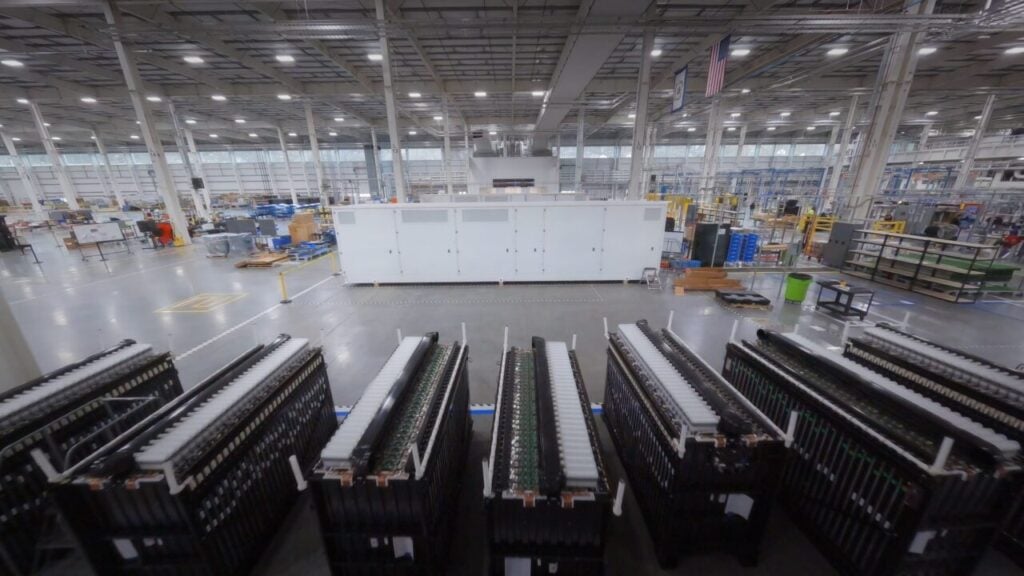
A first project outside the US has been announced by Form Energy, the developer of a novel battery technology promising ‘multi-day’ duration energy storage.
The company, led by former Tesla Energy executive Matero Jaramillo, is commercialising its proprietary iron-air battery, designed to deliver around a 100-hour duration of discharge at full rated power. In very simple terms, the system operates through the reversible oxidation (rusting) of iron, as explained in a 2021 Energy-Storage.news interview with CEO Jaramillo.
Form Energy said yesterday (18 March) that a 10MW/1,000MWh project is planned in Ireland, through a partnership with developer FuturEnergy Ireland.
The startup said it is ‘anticipated’ to come online in 2029, aimed at demonstrating the role multi-day energy storage can play in Ireland’s energy system, from helping the country meet its energy and emissions targets to ensuring reliability, affordability and security of the electricity grid.
Try Premium for just $1
- Full premium access for the first month at only $1
- Converts to an annual rate after 30 days unless cancelled
- Cancel anytime during the trial period
Premium Benefits
- Expert industry analysis and interviews
- Digital access to PV Tech Power journal
- Exclusive event discounts
Or get the full Premium subscription right away
Or continue reading this article for free
Through the Electricity Storage Policy Framework, described by the country’s government as a first-of-its-kind policy when published in 2024, long-duration energy storage (LDES), was identified as key to meeting those goals.
“Form Energy’s battery solution is set to fill a critical gap in Ireland’s power system. Their pioneering 100-hour, iron-air battery technology will provide a first opportunity to deliver large volumes of clean power across multiple days, and in doing so provide a boost to Ireland’s energy goals,” FuturEnergy Ireland CEO Peter Lynch said.
“The technology is modular, scalable and locationally flexible, enabling it to simultaneously solve local grid congestion and the linked issue of wasted renewable power.”
As reported by our colleagues at Solar Power Portal, while Ireland has been successful in growing its share of renewable energy generation, meeting around half of demand with renewables in December 2025, for example, the integration of that renewable energy, particularly wind, has been a new challenge for the grid operator EirGrid, leading to costly curtailment.
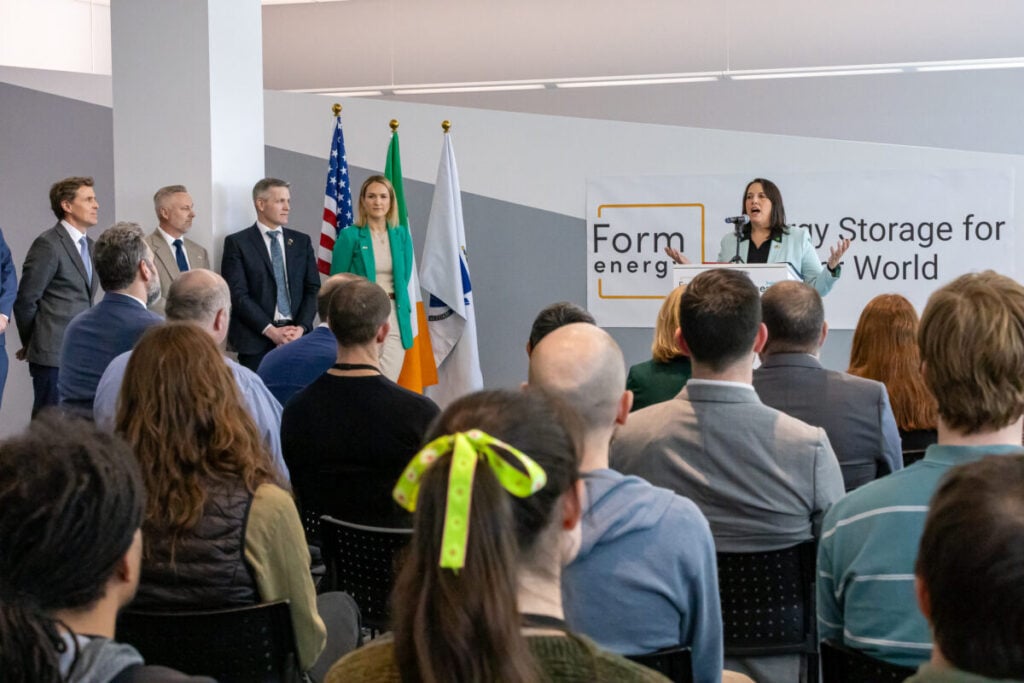
Helen McEntee, minister for foreign affairs and trade and minister for defence for Ireland, attended a signing ceremony on 17 March—St Patrick’s Day—at Form Energy’s Massachusetts, US, headquarters.
McEntee said the partnership “will help boost and expand Ireland’s clean energy usage”, adding that: “Ireland and the United States need to be able to work together to take on today’s challenges, meeting the needs of affordable energy with new technologies.”
Multi-day storage could be widely applicable across Europe
Short-duration energy storage, typically through lithium-ion (Li-ion) battery energy storage systems (BESS), has been effective in filling gaps when the sun isn’t shining and the wind is not blowing, but longer durations, including multiple days, could be useful for helping the grid run on variable renewable energy (VRE) long-term.
After modelling the needs of the German grid, a team from energy consultancy Open Energy Transition wrote in a Guest Blog for Energy-Storage.news published in February that multi-day storage (MDS) “can lower system costs, strengthen grid support, and boost resilience during multi-day gaps.”
The Open Energy Transition authors added that the same approach “applies across Europe.”
The Ireland project comes a few weeks after tech giant Google signed an energy supply deal with utility Xcel Energy for a data centre in Michigan, US, that included, among other resources, 300MW/30GWh of Form Energy iron-air battery storage—making it the biggest announced battery storage project in GWh capacity terms in the world to date.
As explored in a recent ESN Premium article, some questions were raised by industry commentators over the technology’s low round-trip efficiency (RTE) by comparison to lithium-ion, although the counterargument to that is that Xcel and Form Energy believe the iron-air batteries will be low-cost enough, made using abundant materials and performing applications that don’t require frequent heavy cycling, to be cost-effective.
Some other tech companies have also begun looking at the promise of iron-air, with Dutch company Ore Energy grid-connecting a 100-hour pilot project in France with EDF last month. Meanwhile, another US startup, Noon Energy, has recently unveiled a demonstration project for its own reversible solid oxide fuel cell multi-day storage tech.